Real-time connections across our decentralized network.
Live User Activity
Initializing Global Map...
Recently Active Users
Live Network Analysis
Waiting for active connections...
AI in Health: How Artificial Intelligence Is Changing Modern Healthcare | AIToolsA2Z Blog | AIToolsA2Z
Ai in health care
Aug 29, 2026
AI in Health: How Artificial Intelligence Is Changing Modern Healthcare
Mw
Mikel wang
Contributor at AIToolsA2Z
AI in Health: How Artificial Intelligence Is Changing Modern Healthcare
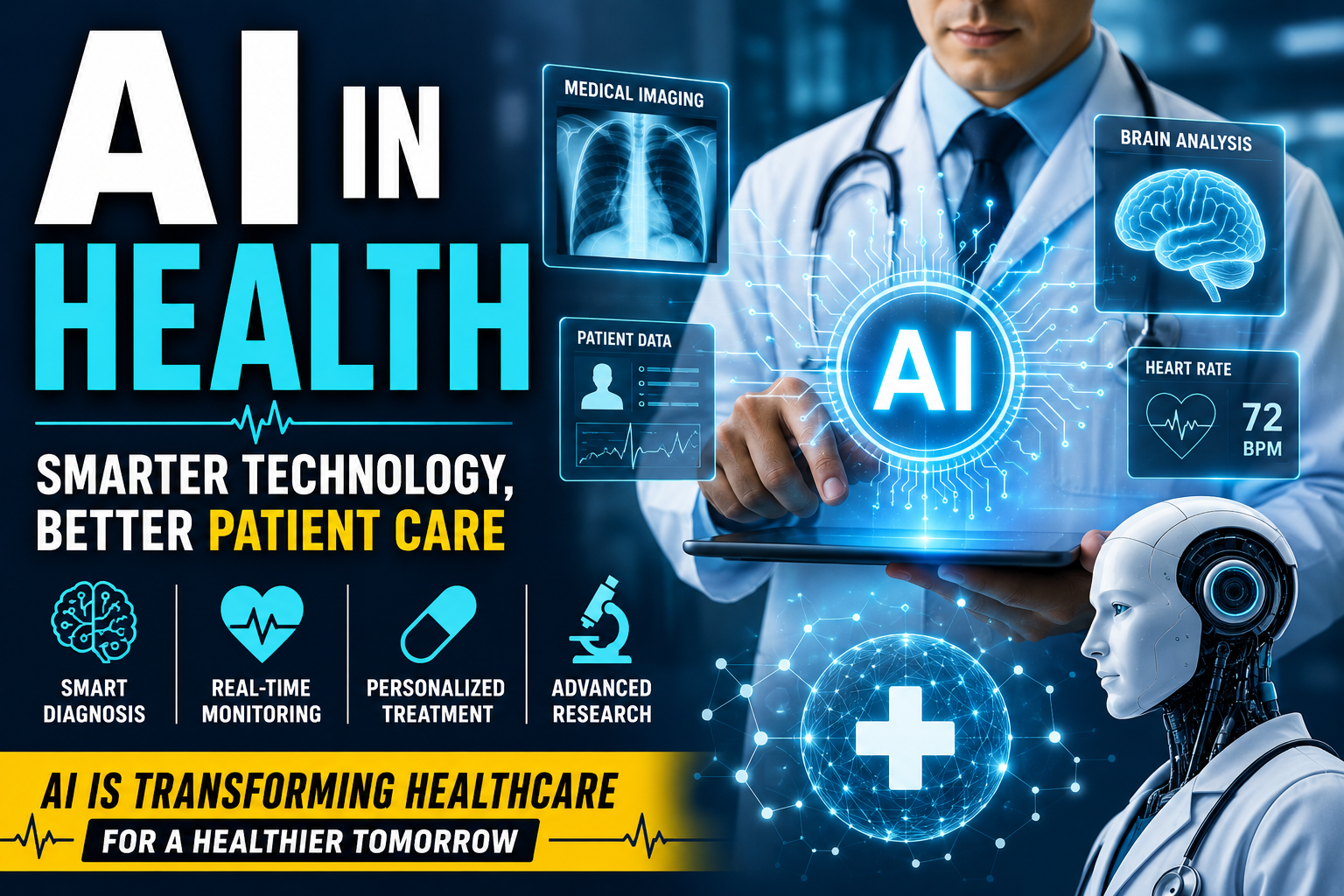
Artificial intelligence is rapidly transforming modern healthcare. From helping doctors analyze medical images to supporting drug discovery and improving hospital operations, AI is becoming an important part of the healthcare ecosystem.
In 2026, healthcare organizations are increasingly exploring how artificial intelligence can improve efficiency, assist medical professionals, and provide patients with more personalized care.
AI does not replace doctors or other healthcare professionals. Instead, its greatest potential is to provide them with powerful tools that can process large amounts of information and help support better-informed decisions.
What Is AI in Healthcare?
AI in healthcare refers to the use of artificial intelligence technologies to analyze medical information, recognize patterns, automate tasks, and assist healthcare professionals.
Modern AI systems can process enormous amounts of data much faster than humans. Depending on the application, AI can analyze medical images, summarize patient information, identify potential patterns in data, assist with administrative work, and support medical research.
The goal is not simply to make healthcare more technological. The goal is to make healthcare more efficient, accessible, and effective while keeping humans involved in important decisions.
How AI Is Changing Modern Healthcare
Artificial intelligence is being applied across many areas of healthcare.
Medical Image Analysis
Medical imaging is one of the most promising applications of AI.
AI systems can analyze images such as X-rays, CT scans, MRIs, and other medical images to identify patterns that may require closer examination.
For example, an AI system can highlight an area on an image that appears unusual, allowing a radiologist to examine it more carefully.
AI can therefore act as an additional layer of assistance rather than replacing medical professionals.
AdvertisementSponsored
Faster Disease Detection
Early detection can be extremely important in healthcare.
AI can analyze large datasets and identify patterns associated with certain diseases or medical conditions. In some cases, these systems can help healthcare professionals identify patients who may need additional testing or evaluation.
However, AI predictions should not automatically be treated as a diagnosis. Medical professionals need to interpret AI-generated results alongside symptoms, medical history, examinations, and other relevant evidence.
Personalized Healthcare
Every patient is different.
AI can help analyze information about an individual patient and support more personalized approaches to healthcare.
For example, AI systems can examine patient records, test results, medical history, and other information to help clinicians consider which factors may be relevant to a particular patient.
This could contribute to more individualized treatment strategies rather than relying exclusively on a one-size-fits-all approach.
AI in Drug Discovery
Developing a new medicine can take years and requires enormous amounts of research.
Artificial intelligence is being used to assist researchers in areas such as drug discovery, molecular analysis, and identifying potential drug candidates.
AI can analyze huge datasets and help researchers identify promising relationships between biological molecules and potential treatments.
This does not mean AI can instantly create a new medicine. Laboratory research, clinical trials, regulatory review, and extensive safety testing remain essential.
Nevertheless, AI has the potential to help researchers explore possibilities more efficiently.
AI-Powered Healthcare Assistants
AI assistants are also becoming increasingly common in healthcare environments.
They can help with administrative and informational tasks such as:
Scheduling appointments
Answering basic questions
Organizing information
Summarizing documents
Supporting patient communication
Preparing administrative notes
Reducing administrative workloads can allow healthcare professionals to spend more time focusing on patients.
However, AI assistants should be carefully designed so that patients understand when they are interacting with an automated system.
AI and Electronic Health Records
Healthcare providers generate enormous amounts of patient information.
Electronic health records can contain medical histories, laboratory results, prescriptions, imaging reports, clinical notes, and other information.
AI can help organize and summarize this information, making it easier for healthcare professionals to locate relevant details.
Instead of manually searching through large amounts of documentation, a clinician may be able to use AI-assisted tools to quickly identify important information.
Human review remains essential because medical records can contain incomplete, outdated, or complex information.
AI in Hospital Management
Artificial intelligence is not only changing clinical care.
Hospitals can also use AI to improve operations.
Potential applications include:
Predicting patient demand
Managing appointments
Optimizing staff schedules
Managing hospital resources
Identifying workflow bottlenecks
Automating administrative processes
Better operational planning can help healthcare organizations use their resources more efficiently.
Benefits of AI in Healthcare
The growing interest in AI in health is driven by several potential benefits.
Improved Efficiency
AI can automate repetitive tasks and process large quantities of information quickly.
Decision Support
AI can provide healthcare professionals with additional information and analytical support.
Earlier Detection
AI-assisted analysis may help identify patterns that deserve further investigation.
Reduced Administrative Work
Automation can reduce time spent on documentation and routine administrative tasks.
Accelerated Research
AI can help researchers analyze large datasets and explore potential scientific relationships.
Challenges and Risks
AI in healthcare also comes with significant challenges.
Patient Privacy
Healthcare data is highly sensitive. Organizations must protect patient information and ensure that AI systems are used responsibly.
Bias in AI Systems
If an AI model is trained on incomplete or unrepresentative data, its performance may differ across populations.
Healthcare organizations need to evaluate AI systems carefully before relying on their outputs.
Incorrect Predictions
AI systems can make mistakes.
A healthcare professional should not blindly follow an AI-generated recommendation, particularly when the decision could have serious consequences for a patient.
Lack of Human Judgment
Healthcare involves empathy, communication, ethical reasoning, and understanding individual circumstances.
These human qualities cannot simply be replaced by an algorithm.
Will AI Replace Doctors?
One of the most common questions surrounding AI in healthcare is whether artificial intelligence will replace doctors.
The more realistic possibility is that doctors who effectively use AI tools may become more efficient than those who do not.
A doctor can combine medical knowledge, experience, communication, physical examination, and patient preferences with AI-assisted analysis.
AI can process information, but healthcare professionals remain responsible for understanding the broader clinical context and making appropriate decisions.
The future of healthcare is therefore likely to involve humans and AI working together rather than AI completely replacing healthcare professionals.
The Future of AI in Health
The role of artificial intelligence in healthcare is likely to continue expanding.
Future systems may become better at integrating different types of information, supporting clinical workflows, assisting researchers, and reducing administrative workloads.
However, responsible development will be just as important as technological progress.
Healthcare organizations will need strong privacy protections, reliable validation, human oversight, transparent systems, and appropriate regulation.
The most valuable healthcare AI will not necessarily be the system that does the most tasks. It will be the system that provides useful assistance while keeping patients safe.
Conclusion
AI in health is changing modern healthcare by providing new ways to analyze information, support medical professionals, improve hospital operations, and accelerate research.
From medical image analysis and personalized healthcare to drug discovery and administrative automation, artificial intelligence has the potential to make many parts of healthcare more efficient.
At the same time, AI comes with important challenges involving privacy, bias, reliability, and human oversight.
The future of healthcare will likely not be about choosing between humans and machines. Instead, it will be about finding the right balance between artificial intelligence and human expertise.
When implemented responsibly, AI can become a powerful healthcare tool—helping professionals make better use of information while keeping patient care at the center of the system.
For more articles about artificial intelligence, technology, and the future of AI, visit AI Brainora.